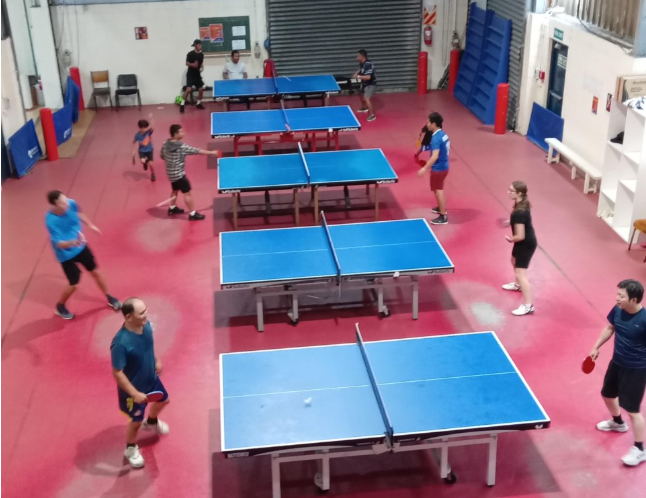
Auckland Council has just released the findings of the “Auckland Indoor Court Supply & Need Study 2026”, a project tasked with the responsibility of identifying indoor court surpluses and deficits within Auckland.
Table tennis was one of the 7 indoor sports studied for the report, with ITTANZ & the Waitakere Table Tennis Association being interviewed and providing formal sector research to the project.
The report graphically reveals that, within the West Auckland boundary, the Waitākere Ranges and Whau have substantial table-tennis surpluses, while Henderson–Massey and Waitematā face shortfalls.
| Local board | Available table-tennis capacity | Provision position |
| Waitākere Ranges | 272 NCE hours/week | Surplus: 241 hours/week (4.8 NCE courts) |
| Whau | 232 NCE hours/week | Surplus: 177 hours/week (3.5 NCE courts) |
| Waitematā | 19 NCE hours/week | Shortfall: 51 hours/week (1.0 NCE court) |
| Henderson–Massey | 18 NCE hours/week | Shortfall: 60 hours/week (1.2 NCE courts) |
Waitākere Ranges & Whau (which are the regions in which ITTANZ and the Waitakere Table Tennis Association have distributed the most table tennis tables within the community) have the strongest table-tennis capacity position in this group.
In contrast, Waitematā (the home of a TTNZ Regional affiliation in Parrs Park, West Auckland) and Henderson–Massey have very limited capacity relative to estimated local demand, with Henderson–Massey showing the slightly larger deficit.
The Waitemata capacity deficit is revealing in that, while Auckland Council invested approximately $800,000 in rebuilding the Waitemata Table Tennis Stadium in 2021, the regional association occupying the Stadium (the TTNZ-affiliated Waitemata Table Tennis Association) has seemingly done very little to grow the sport of table tennis locally, or increase table capacity regionally, since at least 2021.
The study treats indoor courts as a network: surplus capacity in one board may assist nearby areas, but local access can still be affected by travel distance, availability, cost, and scheduling.
This “network” and “local access” finding by Auckland Council in this report powerfully and independently affirms the mission, vision, and premise in the creation of the ITTANZ West Auckland Table Tennis Club Network, and the results of this initiative by ITTANZ for the sport of Table Tennis (the ITTANZ region dominating both growth and capacity outcomes for the sport of table tennis in West Auckland) can now speak for themselves.
Another finding in the report was the absence of formal participation data on the Table Tennis sector as a whole, perhaps most graphically illustrated by this chart:

Source material for Table Tennis for the final report was secured from the following organisations:

Given the various sports venue player capacity deficits across the 7 sports identified in the report, it is likely that single-source sports venues (venues that only host one sport) are going to need to look at ways to assist those sports that need more room to play.
A full copy of the report is attached below.